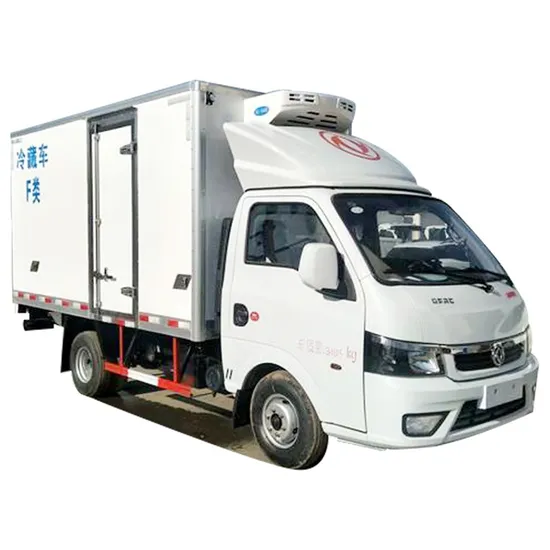
A refrigerated truck serving several shops follows a different work pattern from a refrigerated trailer moving a consolidated load between depots. Start with the shipment and route organization. Vehicle size, loading access and refrigeration duty should follow that description rather than a general preference for a larger or smaller vehicle.
Describe a multi-stop delivery cycle
For local deliveries, record the number of stops, package sizes, quantity unloaded at each point and the time doors are open. Include the parking position and how goods move from the vehicle to the customer. Loading order matters because the first delivery should be accessible without unnecessary rearrangement.
The Dongfeng intercity refrigerated delivery truck lists a 5,520 × 1,820 × 2,590 mm overall envelope and a 3,490 × 1,737 × 1,750 mm van-size entry. Use those as a starting reference for discussing compact delivery access, then request the usable internal dimensions.
Match the delivery vehicle to the batch
The Dongfeng short-haul refrigerated box truck supplies the same listed overall and box dimensions. Its detailed table states a 1,145 kg rated loading capacity, alongside broader payload wording elsewhere. Obtain the loading specification for the selected finished truck rather than treating a general product label as the allowance.
Both delivery references describe 4x2 vehicles and temperature options according to need. Give the supplier the goods' target temperature and loading condition. A short route with many door openings is a different refrigeration duty from a closed-door journey of the same distance.
Describe a consolidated depot-to-depot cycle
For a larger shipment, identify the batch size, loading method, dock dimensions and receiving schedule. Include whether the trailer stays with the tractor, whether another tractor will collect it and how refrigeration is supplied during the planned waiting period.
The Dongfeng tractor and refrigerated-trailer listing provides a trailer reference with a 13,500 × 2,600 × 3,995 mm overall dimension, three axles and an independent refrigeration-unit description. The detailed information concerns the trailer; ask the quotation to identify the tractor and confirm whether it is included.
The trailer page contains different door and internal-dimension versions. Select the required door arrangement and loading envelope in the offer rather than combining the alternatives. Request coupling and complete combination information for the planned tractor-trailer arrangement.
Compare organization as well as space
| Multi-stop distribution | Consolidated depot transport |
|---|---|
| Access at each customer | Access and maneuvering at both depots |
| Door-opening pattern and delivery order | Loading batch, dock process and waiting time |
| Usable box space for the route's packages | Trailer loading layout and combination requirements |
| Cooling duty through repeated stops | Cooling duty through travel and planned parking |
The listings do not establish a temperature-performance ranking between these configurations. Ask for the exact cooling unit and its stated conditions for the chosen box and work pattern. Do not infer refrigeration performance from chassis brand or normal body size.
Send Chengliwei the route, shipment batches, stop pattern, target temperature and loading facilities. Separating local distribution from consolidated transport gives the supplier a clear basis for proposing a rigid refrigerated truck or a tractor-and-trailer solution.